

Photo by pvproductions
As the world changes, one thing is quickly becoming forgotten, and that is that it takes a village. Now, the whole saying goes that “It takes a village to raise a child.” But it’s not only child-rearing that requires the collective help of a community.
We like to think that we’re all individuals working our way through life and the world. The reality is that we aren’t islands. No man is an island, and no single person can fix every problem. But a group of neighbors, grandparents, shopkeepers, and parents working together can change everything. This kind of community support for child rearing and adult care builds real strength from the ground up.
When people want to help their own town or neighborhood, they often look for ideas for local community philanthropy.
Now, a local charity does not require having millions of dollars. Doctor Susan Aurelia Gitelson writes that “the value of [our] activities does not depend only on [our] giving money.”
In actuality, a person can give time, skills, or a small weekly donation. The goal, after all, is to improve the lives of everyone living nearby. Collective responsibility, which we must all start to remember and start applying, means sharing the load. This could either mean that one person watches a friend’s child while another buys groceries for an elderly neighbor. Or a small business owner lets a youth group meet in the back room for free. These small acts pile and pile and pile and pile up until everyone benefits from them, becoming the glue that holds a village together.

Photo by freepik
How It Takes a Village Builds Stronger Social Networks
The importance of social networks cannot be ignored. This is what bedrocks a community and is the foundation of whole civilizations. Without a strong and cohesive social network, what we know of the world wouldn’t have come about–and it’s doubtful we’d even have survived the Ice Age, let alone the many catastrophes, man-made and natural, that have ravaged human civilization since the dawn of time.
Zooming in to a more local perspective: people who know each other’s names and are aware of the other’s struggles are the ones who help more quickly and kindly. Gitelson explains that this “concern for others often leads simultaneously to greater joy for yourself,” which means that, despite some claims against the fact, people are hardwired to help each other–and this joy spreads through every conversation and shared meal.
To build these networks, try these low-cost actions:
- Start a “little free pantry” on a shared property where people can leave or take non-perishable food.
- Create a phone tree for checking on seniors during bad weather or illness.
- Organize a weekly walking group that picks up litter while neighbors chat.
- Host a Saturday morning clothing swap for children’s outgrown clothes.
Every one of these actions strengthens neighborhood involvement in development, helping people feel seen, feel needed, and pushing them organically to act as one. A village that talks and shares becomes a village that thrives together, where the bonds grow tighter, one small gift of time or kindness at a time.
Collaborative Strategies That Bring Real Change
Collaborative strategies work better than solo efforts. When a hurricane comes and sweeps away everything, one man alone is not enough–not even close–to mend what nature has wrought. Likewise, a single family cannot run a free tutoring program by itself, but five families can take turns, helping each other and filling each other’s gaps. Going even further, two churches and a local library can share a building for a weekly hot meal, lending these families and the students they’re tutoring a safe space.
Here are ideas for local community philanthropy that your locale might want to consider and implement:
- Start a skill-sharing roster that recommends which townsperson can fix leaky faucets, teach basic math, or help with smartphones.
- Create a carpool co-op for doctor visits, grocery runs, and school pickups. This is especially helpful, given current circumstances.
- Organize a quarterly “village clean and repair day” where teams fix playground benches, plant flowers, and paint faded crosswalks.
- Form a village tool library where neighbors borrow and return lawnmowers, hammers, and ladders.
Gitelson notes that “the giving process enriches life for both donors and recipients,” and everyone wins when people pull together.
These projects need little money, but they do require collective responsibility and a shared calendar. It takes a village to keep the tool shed organized, and it takes a village to remember who drives on Tuesdays. This might be difficult at first, considering that the idea of individualism is so deeply ingrained in everybody that, often, the idea of collective effort elicits an apathetic response at best.
But the result is a place where no family struggles alone, and everyone pitches in for a shared and brighter future.

Photo by DC Studio
The Spirit of Collectivism
When we realize that we are all in this together and that the world doesn’t have to be navigated alone, the village transforms into a safety net made of ordinary people choosing to care about their fellow man and returning to the old principles that founded civilization.
This same spirit of local giving can grow into larger projects that involve more and more people: a neighborhood that shares tools can also raise money for a community garden, while a group that drives seniors to appointments can also collect winter coats for children.
These acts go on and on until everyone else’s needs are met, and we create a world wherein trust is pre-packaged with being alive.
That’s basically how modern society was made: when families helped each other, becoming communities, and then communities helped each other, becoming larger settlements, and so on and so forth until cities were made and civilization came about.
Gitelson’s book proves that small, steady actions create lasting impact. Everyone has something to give. The only question is where to start.
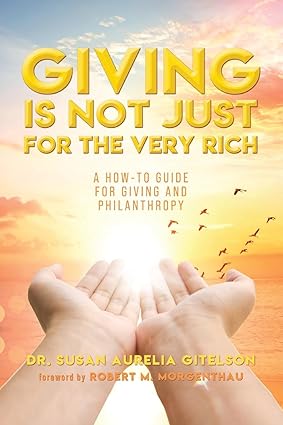
Ready to turn your own block or town into a giving village? Get Dr. Susan Aurelia Gitelson’s Giving Is Not Just For The Very Rich. It is packed with simple, powerful steps for anyone who wants to help others and feel more joy.

0 Comments