

Photo by freepik
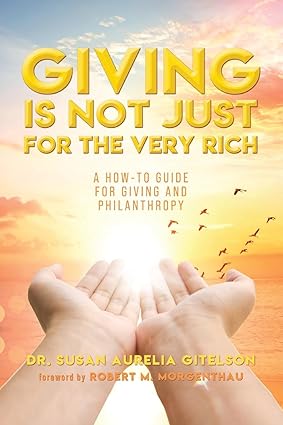
Corporate philanthropy is how businesses give back to society. When companies use their resources, skills, and people to help others, everyone benefits. These ideas are the basis of Dr. Susan Aurelia Gitelson’s book, Giving Is Not Just For The Very Rich.
In this article, we will showcase famous and influential examples of corporate philanthropy that have actually changed the world for the better.

Photo by tirachardz
The Early Days of Corporate Philanthropy
Some of the earliest and most enduring examples of corporate philanthropy come from companies that were established in the early twentieth century.
The Rockefeller Foundation
Founded in 1913 with funding from Standard Oil, the Rockefeller Foundation is among the oldest examples of corporate philanthropy. With a substantial endowment and a community-minded approach focused on public health, medical education, and scientific research, the foundation helped fund schools of public health and fought diseases such as hookworm and yellow fever.
Its work showed how business wealth could address major problems worldwide.
The Ford Foundation
Founded in 1936 with gifts from the Ford family and the Ford Motor Company, the Ford Foundation became a major philanthropic force that still bears an impact today with the aim of helping “strengthen democratic values, reduce poverty and injustice, promote international cooperation, and advance human achievement.”
This foundation proves that corporate philanthropy can have a long-term mission.
Corporate Philanthropy in the Modern World
Today’s companies often blend charity with their business ventures, helping to ensure that the altruism they provide is efficient and effective. They look for “strategic intervention points,” as Melinda Gates calls them, to create the most change.
The Google.org Model
When Google went public in 2004, its founders, Larry Page and Sergey Brin, pledged to use 1% of its profits and equity to “make the world a better place.” Google.org is an excellent example of corporate philanthropy leveraging its technology for a good cause. The company has made countless contributions to addressing climate change, advancing clean energy, and improving global health.
This shows how digital platform expansion, which often serves as a company’s core technology, can become a tool for the greater good..
The Starbucks “Create Jobs for USA” Program
In 2011, Starbucks CEO Howard Schultz launched a grassroots fund to make loans to small businesses in struggling communities: Starbucks customers could buy a special wristband, and all proceeds from its sale went to nonprofits that backed community lenders.
The Create Jobs for USA program combined customer donations, corporate funds, and foundation money, making it an aspirational example of a seamless matching program that makes it easy for everyone—the company, its workers, and its customers—to join in.
Employee-Driven Corporate Philanthropy
The best programs often come from within a company, starting the change from within and then radiating outward. These employee-driven grantmaking models put power in the hands of a company’s employees, which just goes to show that you don’t need to be super rich to change the world for the better.
The Microsoft Employee Giving Program
Microsoft matches donations its employees make to charities and pays them for the time they spend volunteering, having generated billions of dollars for nonprofits worldwide.
It works because it trusts employees to support causes they care about.
Microsoft then provides a matching program that doubles the impact of each employee.
This is a perfect model of corporate philanthropy that is personal and effective.
Salesforce’s 1-1-1 Model
Salesforce gives 1% of its product, 1% of its equity, and 1% of its employees’ time back to the community. This means employees are given paid time off to volunteer for community programs.
This model has inspired hundreds of other companies to follow the same pledge, helping remind businesses and communities of the critical and reciprocal relationship they share.
The 1-1-1 Model creates a culture of giving inside the business and has supported thousands of schools and nonprofits.
Impact Reporting and Analytics
Innovative corporate philanthropy doesn’t just give and forget. If one’s model of charity follows that mantra, then nothing would get done, and nothing would change.
Companies use impact reporting and analytics to see what works, helping them answer important questions: whether their programs are actually working and, if so, what can be done to make them more efficient and effective.
Giving Is Not Just For The Very Rich advises donors to always ask tough questions to better allocate their time and effort for a just and better world–questions like:
“What percentage of the funds they collect actually go to the cause?” or “How effective are they?“
The Robin Hood Foundation (supported by Wall Street firms) applies this strictly, together with other organizations, where they measure results as if they were conducting a business.
Since board members cover all administrative costs, the group can allocate 100% of public donations to programs without additional cost, smartly seeking “the best returns through evaluating and measuring the results.”
This is impact reporting and analytics in action, ensuring every dollar does its job and is never wasted.

Photo by senivpetro
Why Corporate Philanthropy Matters
These examples of corporate philanthropy show that giving back is wonderful for business, as well as for the world.
Although it might necessarily generate profit, it builds customer trust, motivates employees, and solves real problems–which is equally as important for long-term survival and growth.
As Dr. Gitelson writes in Giving Is Not Just For The Very Rich:
“Giving is for all of us, who, in our own ways, have the power and the capacity to make a difference.”
This includes companies.
The corporate philanthropy examples above prove that you don’t have to be a billionaire to change the world. You don’t even need to be a CEO or anything.
With thoughtful planning, employee passion, and a focus on real results, any business can be a force for good.
The key, as always with everything, is to start, to be thoughtful, and to keep learning what works.
Grab a copy of Giving Is Not Just For The Very Rich NOW and discover more about how you or your company can make a lasting impact!

0 Comments
Trackbacks/Pingbacks